Why Walking Helps You Process: The Nervous System Science Behind Outdoor Therapy
There's a reason some of the most honest conversations of your life happened on a walk.
Not in a therapist's office. Not at a kitchen table. On a trail, or along the water, moving side by side with someone you trusted — and something opened up that hadn't been able to open anywhere else.
This isn't a coincidence. There's real science behind why movement and outdoor environments change what becomes available to us emotionally. And for people doing deeper healing work — around trauma, relational patterns, or early experiences — understanding that science can make the difference between therapy that stays cognitive and therapy that actually lands in the body.
Your Nervous System Is Always Reading the Room
Before we can talk about why walking helps, it helps to understand what the nervous system is actually doing during a therapy session.
Your autonomic nervous system — the part of your nervous system that operates below conscious awareness — is constantly scanning your environment for cues of safety or danger. This process, which researcher Stephen Porges called neuroception, happens faster than thought. Before you've registered anything consciously, your nervous system has already made an assessment and begun adjusting your physiology accordingly.
In a traditional therapy office, that assessment can go a few different ways. For many people, an office feels safe enough — contained, private, warm. But for others, particularly those with trauma histories or chronic patterns of hypervigilance, the stillness of an office, the direct face-to-face positioning, the enclosed space, can keep the system on a low-level alert that makes deeper processing harder to access. The work can feel effortful. Words come, but something stays locked.
What Happens When You Start Moving
Gentle rhythmic movement — the kind you get from walking at a comfortable pace — has a measurable effect on the nervous system.
Bilateral stimulation, the alternating left-right activation that happens naturally when you walk, is thought to support the integration of difficult material. It's one of the mechanisms researchers believe underlies the effectiveness of EMDR therapy, which uses deliberate bilateral eye movements or taps to help process traumatic memories. When you walk, you get a gentler, more continuous version of this same effect.
Movement also increases levels of BDNF (brain-derived neurotrophic factor), sometimes called "fertilizer for the brain." BDNF supports neuroplasticity — the brain's ability to form new connections and update old patterns. Therapy, at its core, is asking the brain to update patterns. Movement creates more favorable conditions for that updating to happen.
And then there's the simple fact of physical discharge. Many people carry unprocessed stress and emotion in the body as chronic tension — shoulders, jaw, gut, chest. Walking gives the body somewhere to put that energy. As it moves through the muscles and out, there's often more room for emotional material to surface and be worked with.
Polyvagal Theory and the Outdoors
Polyvagal theory, developed by Dr. Stephen Porges, describes three states the autonomic nervous system moves through in response to perceived safety or threat:
Ventral vagal — the social engagement state. This is where we feel safe, connected, and open. It's where meaningful therapy happens.
Sympathetic activation — the fight-or-flight state. When threat is perceived, the system mobilizes. We become reactive, scanning, defended.
Dorsal vagal — the shutdown state. When threat feels overwhelming and escape impossible, the system collapses into numbness, disconnection, or freeze.
Most people doing trauma work spend at least some time in sympathetic activation during sessions — the material activates the system. The therapeutic task is to stay within what's called the window of tolerance: activated enough to access the material, regulated enough to process it.
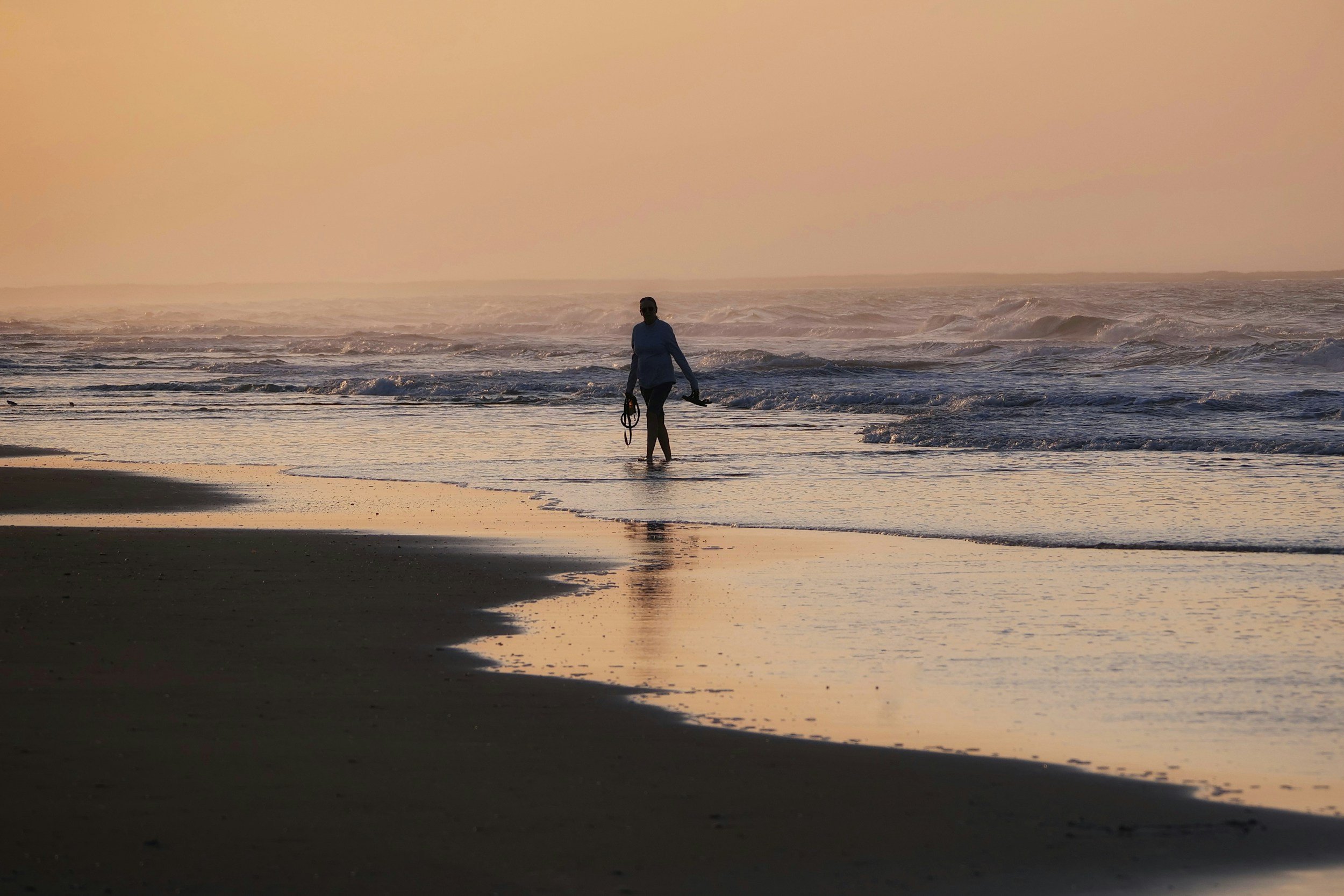
The outdoor environment offers something that's hard to replicate indoors: a natural array of what Porges calls neuroceptive cues of safety. Natural light, open sightlines, fresh air, the sound of birds or water, the rhythmic sensation of walking — all of these register below conscious awareness as signals that the environment is safe. The nervous system, reading these cues, often settles in ways it doesn't in a static indoor space.
Side-by-side positioning matters too. Face-to-face conversation activates a more evaluative, socially vigilant mode. Walking together beside someone reduces that vigilance. It's harder to feel scrutinized when you're both looking at the same horizon.
What This Means for Trauma and Attachment Work
For people healing from complex trauma or relational wounds rooted in early experiences, this all has particular relevance.
Early trauma — especially the kind that happened in relationship, where safety and danger were bound up with the same people — often leaves the nervous system in a state of chronic readiness. The body learned to brace. Protective adaptations formed. And those adaptations don't always turn off in a therapy office just because the intellectual mind knows it's safe.
Movement, nature, and open space can reach that system in ways that conversation alone sometimes can't. The body begins to register safety not as a concept but as a felt experience. And from that more settled place, the deeper material becomes more accessible — not because we've forced it, but because the conditions have shifted.
This is particularly relevant for work with parts. In Internal Family Systems, protective parts — the managers and firefighters who learned to keep vulnerable parts safe — often relax their guard when the body is moving and the environment feels open. Not always. Not on a schedule. But often enough that outdoor sessions create windows of access that are harder to find indoors.
When Outdoor Therapy Is and Isn't a Fit
Outdoor therapy isn't right for every person or every moment in the work.
It tends to be a particularly good fit for people who feel restless or constricted in office settings, who carry a lot of energy in the body and find movement regulating, who feel more comfortable in side-by-side conversation than face-to-face, or who have a strong connection to nature and find that the natural world itself is part of what helps them feel settled.
It's generally not the right container for formal EMDR processing, which benefits from a controlled, still environment. It may not be the right choice during periods of acute crisis, when containment and structure are more important than openness. And it requires some flexibility around weather and privacy that not everyone will find easy.
The best approach is usually to let the work guide the format — some sessions benefit from being outside, others from the held quality of an office. Many people find that alternating between the two, depending on what they're moving through, gives them access to a fuller range.
Outdoor Therapy in Del Mar, Solana Beach, and Cardiff
If you're in the north San Diego area and curious about what walk and talk therapy might open up for you, I offer outdoor sessions along the coast — at the Del Mar Bluffs, Tide Beach Park in Solana Beach, and San Elijo Lagoon in Cardiff by the Sea, drawing on somatic, IFS, and EMDR-informed approaches.
Sessions are the same length and rate as standard individual therapy. We discuss location together and adapt to your pace, your access needs, and what the work calls for.
You can learn more about walk and talk therapy sessions here, or reach out directly if you have questions.
